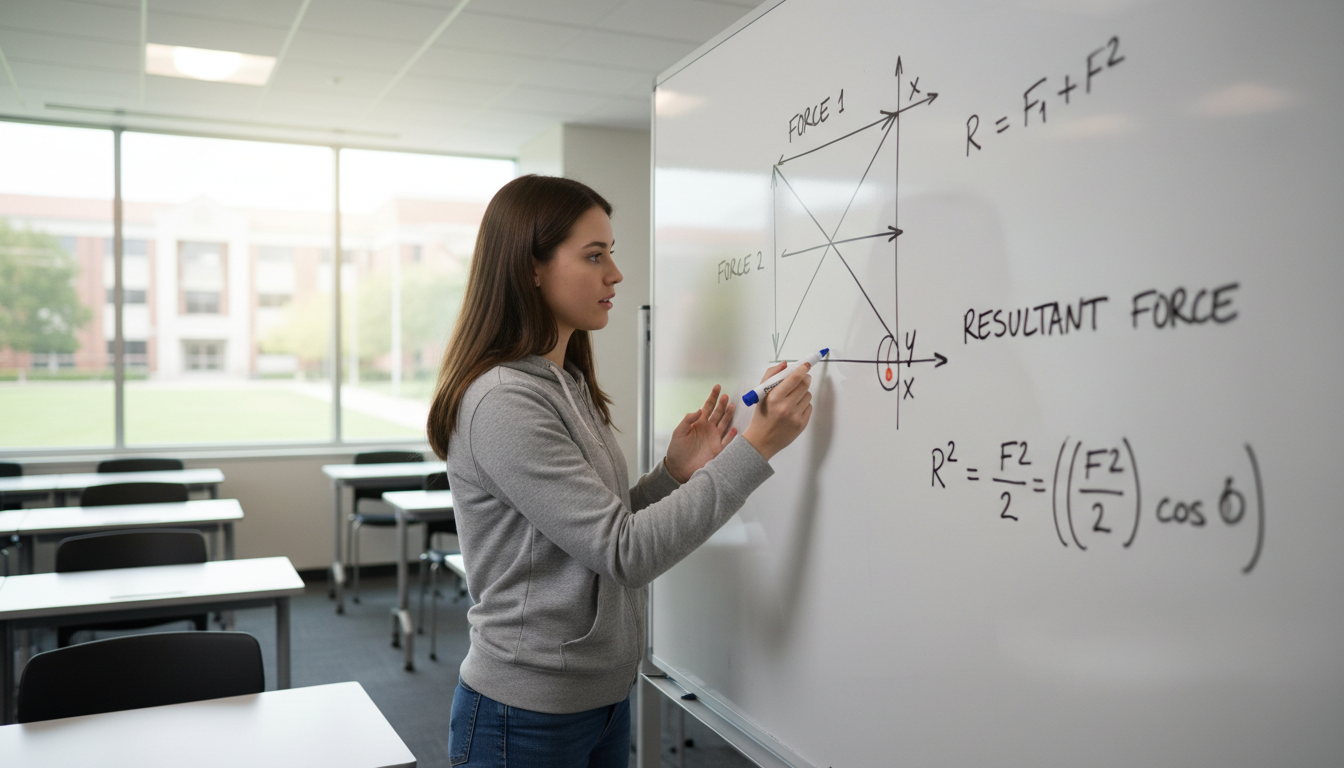
Many students find A level maths mechanics hard because it requires a conceptual shift from abstract algebra to physical modeling and diagrammatic analysis. The difficulty often stems from silent mark killers like incorrect force diagrams or failing to correctly link kinematic variables to algebraic equations. Success requires treating mechanics as an extension of pure mathematics while focusing on the precise translation of physical scenarios into solvable models.
Many students find that their mastery of integration and trigonometric identities fails to translate into high scores when faced with a complex kinematics diagram. You might excel at manipulating abstract equations, yet feel completely paralyzed by a question involving frictional forces or resolving components on an inclined plane. This disconnect represents a significant barrier to achieving top marks; it is rarely a lack of mathematical talent but rather a failure in translating physical reality into algebraic models. In this guide, we analyze the specific paradox facing pure maths students and identify the silent mark killers that systematically drain your results. We will explore how to bridge the gap between physical scenarios and pure algebra, address common pitfalls in Edexcel moments and projectiles, and introduce a data driven diagnostic approach to refine your mechanics performance.
The Pure Maths Paradox: Why Top Algebra Students Struggle with Mechanics
It is a frequent and frustrating phenomenon for high performing students. You might be comfortable navigating complex integration or solving intricate trigonometric identities; however, as soon as a particle begins moving along a horizontal plane or a beam is placed in equilibrium, your grades start to slip. This leads many to ask: why is a level mechanics so hard compared to the pure modules?
The answer rarely lies in a lack of mathematical ability. Most students struggling with mechanics possess the underlying algebra and calculus skills required to solve the problems. The disconnect occurs during the translation phase, where a physical scenario described in text must be converted into a formal mathematical model. At DataTutors, our founder experienced this exact hurdle firsthand. Moving from a D to an A grade during his own A Levels required a shift in perspective; he realized that mechanics is not a separate subject but rather the application of pure maths to the physical world.
Consider a standard constant acceleration problem. The question might describe a particle with an initial velocity and a specific displacement. The mechanics part of the challenge ends once you have correctly selected and populated the equation $s = ut + \frac{1}{2}at^2$. At that point, the problem becomes a standard quadratic equation. If you can solve $t^2 + 4t - 20 = 0$, you have the maths. The struggle is identifying the variables within the text and defining the physical constraints. We use diagnostic assessments to determine if a student is failing due to this translation logic or if there are genuine gaps in their pure foundations. Understanding this distinction is the first step toward peak performance.
The Three Silent Mark Killers in A Level Maths Mechanics
Identifying the translation gap is only half the battle. To stop your grades from slipping, you must address the three specific habits that frequently sabotage pure-strong students. These errors are often the reason why a student can understand the theory but still fail to produce the correct a level maths mechanics questions and answers during a timed paper. At DataTutors, we use our diagnostic assessments to determine which of these three killers is most prevalent in a student's work.
Diagram Neglect: Pure students often attempt to jump straight to the algebra, treating the physical description as a word problem that can be solved mentally. In mechanics, a force diagram is not a decorative illustration; it is a mathematical necessity. Failing to draw every force, such as the normal reaction or the resolved components of weight ($mg \sin \theta$ and $mg \cos \theta$), almost guarantees a missing term in your resultant force equation. Without a visual map, you are effectively trying to solve a puzzle with half the pieces missing.
Vector Sign Errors: In calculus, you rarely have to decide which way is positive. In mechanics, failing to define a clear coordinate system is a leading cause of dropped marks. If you define 'up' as positive for a projectile, the acceleration due to gravity must be entered as $-9.8 m/s^2$ in your SUVAT equations. Students who mix signs, such as using a positive initial velocity and a positive acceleration for a ball thrown upwards, will arrive at physically impossible answers. Consistency is more important than the specific direction chosen.
Keyword Blindness: The exam board uses specific 'codewords' to simplify the mathematical model. 'Smooth' tells you to ignore friction; 'light' means you can neglect the mass of a string or pulley; 'inextensible' indicates that two connected particles will share the same magnitude of acceleration. Ignoring these terms leads to a search for variables that do not exist, causing unnecessary panic. We teach our students to treat these keywords as mathematical constants rather than descriptive adjectives. By mastering this vocabulary, you ensure that the model you build matches the one the mark scheme expects.
Bridging the Gap: Turning Physical Scenarios into Pure Algebra
Generic advice like 'just do more practice' often found on student forums ignores the fundamental need for a structural framework. To master a level maths mechanics hard questions, you must treat the transition from a diagram to an equation as a systematic three-stage process. Consider a particle of mass $m$ sliding down a rough inclined plane at an angle $\alpha$. Pure students often hesitate here, but the complexity is an illusion that disappears once you apply a rigorous methodology.
First, align your coordinate system with the direction of motion. Instead of standard horizontal and vertical axes, define your directions as parallel and perpendicular to the plane. This single step simplifies the vector components significantly. Second, resolve all external forces into these two directions. This is the moment mechanics turns into the trigonometry you already master. The weight $mg$ acting vertically downwards must be resolved into $mg \sin \alpha$ acting down the plane and $mg \cos \alpha$ acting into the plane.
Third, construct your equations of motion using Newton's Second Law, $F=ma$. Perpendicular to the plane, where there is no acceleration, you have $R - mg \cos \alpha = 0$. Parallel to the plane, you have $mg \sin \alpha - F_r = ma$. By substituting the friction formula $F_r = \mu R$ into your parallel equation, the mechanics portion of the task is complete. You are left with a single algebraic expression that requires basic rearrangement to find acceleration or the coefficient of friction.
Our diagnostic assessments often reveal that students fail here not because of a lack of knowledge, but because of a lack of structure. If the struggle lies in trigonometric resolution or a failure to set up the simultaneous equations, we address it through custom revision timetables that prioritize these specific logical transitions. If you find this process overwhelming, you can book a free consultation to see how we apply this data-driven methodology to your specific weak points and help you reach your full potential.
Edexcel Specific Pitfalls: Moments and Projectiles
For students following the Edexcel specification, the heavy hitter topics of moments and projectiles represent the steepest part of the learning curve. These modules are high yield, appearing consistently on Paper 3, yet they are where even the most capable pure mathematicians falters. In a level maths mechanics moments questions, Edexcel often introduces non-uniform rods or ladders resting against rough walls. The difficulty here is rarely the principle of moments itself; it is the necessity of resolving forces at multiple angles simultaneously. If your trigonometry is not intuitive, you will struggle to calculate the perpendicular distance from the pivot, leading to an immediate loss of marks.
Projectiles present a different challenge, often requiring students to find the point of impact or the time of flight by solving simultaneous equations involving both horizontal and vertical components. Edexcel frequently integrates these with complex algebraic manipulation, such as expressing the range in terms of $g$ and $\tan \theta$. A common pitfall is the precision required; Edexcel is notoriously strict regarding the use of $g = 9.8$, where final answers must usually be rounded to two or three significant figures to match the precision of the constant used. Standard pure maths habits of leaving answers in exact surd form can actually lead to dropped marks here.
To master these A level maths mechanics hard topics, we provide students with proprietary test materials that are intentionally designed to be more challenging than the actual exam. By practicing with these stress-test problems, the real Edexcel questions feel significantly more manageable under timed conditions. We use diagnostic assessments to ensure your trigonometry and algebraic substitution are robust enough for these specific applications. If your recent work shows a weakness in these high-yield areas, you can book a free consultation to receive a custom revision timetable that targets these Edexcel specific pitfalls.
Is A Level Maths Mechanics Harder Than Physics?
Students frequently ask if A-Level Maths Mechanics is harder than the equivalent modules in A-Level Physics. While the two subjects share a significant syllabus overlap, including topics like SUVAT, vectors, and Newton’s Laws, the nature of the challenge is distinct. Physics focuses heavily on the conceptual 'why,' rewarding students for their understanding of physical principles and their ability to describe real-world applications. Conversely, A-Level Maths Mechanics demands rigorous proof and algebraic exactness. You are often expected to manipulate variables without numerical values or leave answers in terms of $g$, requiring a level of mathematical fluency that Physics does not always mandate.
For those debating between maths or physics A-Level for medicine, this distinction is vital. Medical admissions tutors value the logical precision developed in the maths module. At DataTutors, our founder leveraged this exactness to transition from a D to an A grade, eventually securing a place at Imperial. If you find the maths side more challenging despite doing well in Physics, it usually indicates a gap in your ability to translate physical concepts into pure algebraic proofs. We use diagnostic assessments to isolate these specific hurdles. By refining your technique, you can master the high level of accuracy Edexcel requires. To start building a custom revision timetable, you can book a free consultation today.
How to Improve at A Level Mechanics: The Data Driven Diagnostic Approach

Improving your performance in mechanics requires moving beyond the "practice makes perfect" mantra. At DataTutors, we begin with diagnostic assessments designed to pinpoint the exact failure point in your problem-solving process. Many students find a level maths mechanics hard because they cannot distinguish between a breakdown in physical modeling and a gap in their pure maths foundations. If you can set up a constant acceleration equation but fail to solve the resulting quadratic, your hurdle is algebraic, not mechanical. Conversely, if the algebra is sound but your force diagrams are consistently missing the normal reaction, the issue is structural logic.
Once we identify these specific blockers, we provide a personalized action plan. This strategy translates into custom revision timetables that prioritize high-impact topics over general review. By bridging these gaps systematically, you can transition from confusion to consistent performance. To see how our data-driven approach can elevate your grade, you can book a free consultation and receive a specialized roadmap for your A-level journey.