Receiving Year 12 A level maths mock results lower than expected is a common starting point for many students who eventually see a one to two grade improvement before their final exams. You should use these results to identify specific knowledge gaps, switch to active recall study methods, and create a structured revision plan based on teacher feedback. This diagnostic approach allows you to address weaknesses early and build the confidence needed for academic success.
Seeing a grade on your Year 12 A Level Maths mock that sits significantly below your potential is a sobering moment for any high achieving student. It is not just about the number on the page; it is about the sudden uncertainty surrounding your UCAS predicted grades and your readiness for the Year 13 transition. However, these results serve as vital diagnostic data rather than a final verdict on your mathematical ability. In this guide, we will move beyond generic study advice to provide a technical framework for your academic recovery. You will learn how to perform a rigorous diagnostic on your script to identify whether your issues are conceptual or procedural. We will also cover how to bridge specific gaps in Pure and Mechanics, strategies to pivot from a Grade D to an A, and the professional way to manage your predicted grades before university applications.
Why Year 12 A Level Maths Mock Results Matter More Than You Think
It is common to feel a sense of dread when you see your Year 12 A level maths mock results lower than expected, especially when you have invested significant time into your revision. This feeling is valid; A-Level Maths represents a substantial jump in rigor from GCSE, and the mock exam is often the first time you are tested on the full breadth of the Year 12 specification under timed conditions. However, it is essential to view this result as a pivot point rather than a final judgment.
At DataTutors, we view these results as a snapshot of your current performance, not a ceiling on your potential. Our founder experienced this first hand, moving from a grade D to an A by shifting from passive note-taking to a rigorous, data-driven approach. In the competitive London academic landscape, these mocks carry weight because they directly inform your UCAS predicted grades and Year 13 class placements. These predictions are the primary gatekeepers for your university applications, making this the moment to recalibrate your strategy rather than simply working harder at the same ineffective methods.
For Edexcel students, the Year 12 content is the fundamental infrastructure for the entire course. If your understanding of basic differentiation, integration, or coordinate geometry is shaky, the complex calculus and advanced mechanics modules in Year 13 will feel inaccessible. Treating this mock as a critical diagnostic moment allows you to identify these structural weaknesses before they compromise your final grade. By building a data driven recovery plan, you can transform a disappointing mock result into the roadmap for your eventual success.
Immediate Steps After Receiving Disappointing Mock Exam Results
When your Year 12 A level maths mock results lower than expected, your priority must shift from emotional reaction to analytical audit within the first 24 hours. The pressure in London to secure placements at competitive universities like Imperial or LSE is intense, but panic is the enemy of a strong UCAS application. Staying calm and objective is the first requirement for a recovery that satisfies entry requirements.
First, secure your physical exam script and the official Edexcel mark scheme. Many students make the mistake of looking only at the grade on the front page. To recover, you must separate the 'grade,' which is a static number, from the 'feedback,' which is the raw data required for improvement. Reviewing your script alongside the mark scheme allows you to see exactly where the examiner stopped awarding marks.
During this initial window, do not pick up a textbook to 'study harder.' Instead, create a simple list of every question where you dropped marks. This objective distance is the first step in a diagnostic first Year 12 mock revision strategy. By treating the paper as a set of data points rather than a personal failure, you provide your teachers with the evidence of a professional mindset. This analytical approach is what ultimately convinces departments to maintain your predicted grades despite a temporary setback.
Perform a Data Driven Diagnostic on Your Mock Paper
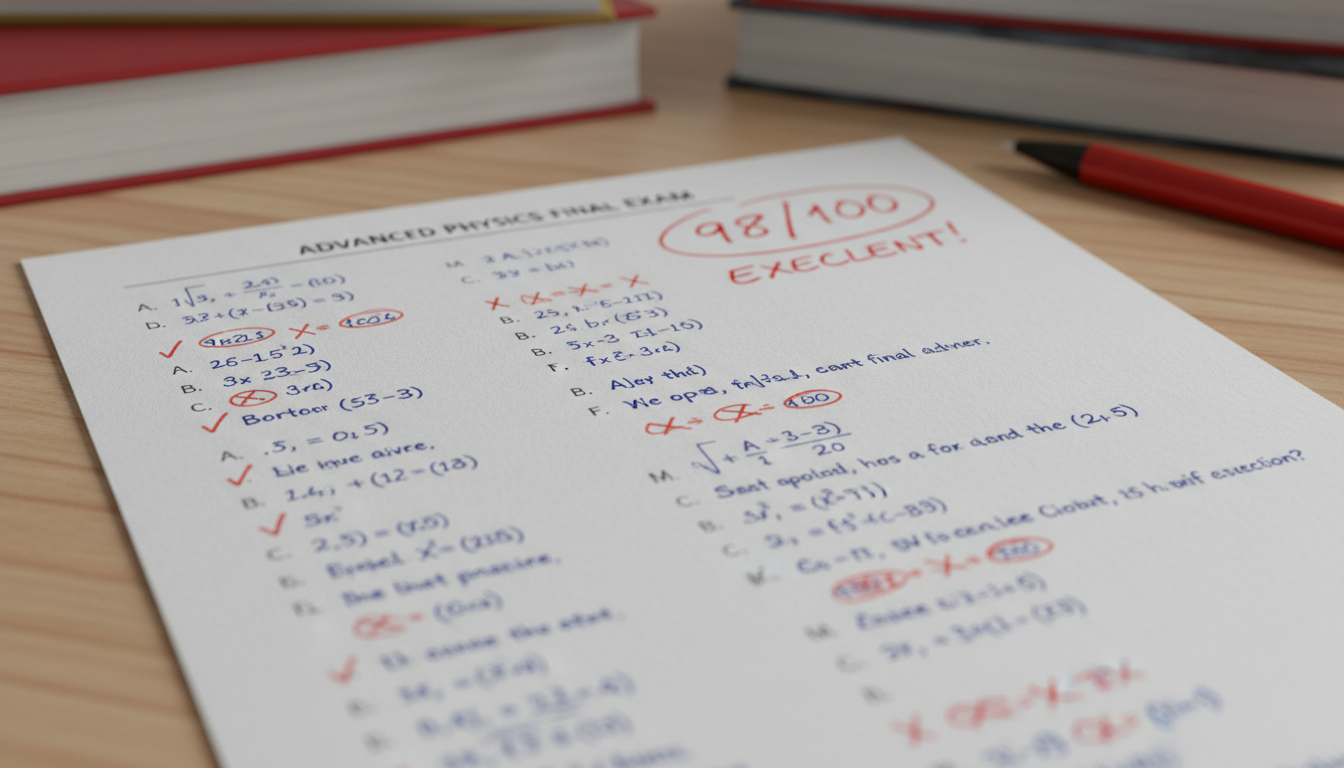
With the right mindset established, the transition from reflection to action begins with a granular audit of your script. At DataTutors, we believe that every lost mark is a data point that reveals a specific deficiency in your current preparation system. If your Year 12 A level maths mock results lower than expected, you must move beyond the final score and categorize every lost mark into one of three distinct buckets: Knowledge Gaps, Application Errors, or Execution Flaws.
Knowledge Gaps occur when you simply do not know the required material. This is a failure of memorization or initial conceptual understanding. For example, in the Edexcel Pure Mathematics specification, this might manifest as failing to recognize when to use the small-angle approximation for trigonometry, such as substituting $\cos(\theta)$ with $1 - 0.5\theta^2$. If you looked at a question and did not know which formula to pull from your toolkit, it belongs in this bucket.
Application Errors are the most common hurdle for Year 12 students. You may know the formula, but you struggle to apply it within the context of a multi-step problem. A classic example is knowing how to find a derivative but failing to connect that process to finding the equation of a normal in a coordinate geometry question. You have the tools, but you lack the mathematical logic to construct a solution path. This is often where students lose the most marks on the "problem solving" and "modelling" questions that Edexcel prioritizes.
Execution Flaws are often dismissed as "silly mistakes," but they are actually systematic errors in exam technique. This includes leaving your calculator in degrees during a radians-based calculus question, misreading a question that asks for an "exact value," or the frequent error of forgetting the constant of integration ($+c$). It also covers marks lost to poor time management, such as leaving a high-weighting mechanics question blank at the end of the paper.
Error Category | Specific Edexcel Example | Primary Recovery Focus |
|---|---|---|
Knowledge Gap | Forgetting the formula for the area of a sector | Active recall and flashcards |
Application Error | Identifying the correct SUVAT equation in a complex projection | Topic-specific drilling |
Execution Flaw | Missing the $+c$ in an indefinite integral | Exam technique and proofreading |
By quantifying these errors in a spreadsheet, you move toward a diagnostic first Year 12 mock revision. This objective data reveals whether you need to revisit the textbook or increase your exposure to our harder-than-exam proprietary materials. To begin transforming this data into a strategy, you can book a free consultation and receive a data driven recovery plan tailored to your specific error profile.
How to Bridge Knowledge Gaps in Pure Maths and Mechanics
Translating the data from your audit into a tangible study plan requires a shift in how you view the Edexcel specification. The jump from GCSE algebra to A-Level rigor is often where students see their Year 12 A level maths mock results lower than expected. The algebra that felt intuitive at Grade 9 often breaks down when faced with the multi-step proofs and complex manipulations required in Pure Mathematics.
To bridge these gaps, DataTutors utilizes a "Diagnostic First" method. Rather than passively reading through a textbook, you must start by attempting a set of targeted, high-difficulty questions on a specific topic without your notes. This process exposes "hidden" gaps where you might understand the concept but lack the algebraic dexterity to reach the final answer. For instance, many students lose marks in coordinate geometry because they cannot fluently manipulate the $y - y_1 = m(x - x_1)$ formula when gradients are given as fractional perpendiculars. By identifying these specific friction points before you begin your review, your revision becomes a surgical strike rather than a generic overview.
Prioritize high-weighting topics that form the bedrock of Year 13. Differentiation and coordinate geometry appear in nearly every subsequent module; a weakness here will make Year 13 calculus impossible to navigate. In Mechanics, focus on resolving forces and the precise application of SUVAT equations. A diagnostic first Year 12 mock revision helps you determine if your errors in Mechanics are due to a misunderstanding of the physical system or simply a failure in the underlying trigonometry. In the competitive London academic environment, efficiency is your greatest asset. Focusing on these high-yield areas ensures your recovery plan yields the maximum possible improvement in the shortest time.
Moving from Grade D to A: Strategic Revision Techniques

Improving your performance after finding your Year 12 A level maths mock results lower than expected requires abandoning "safety blanket" revision. Many students spend hours highlighting notes or re-reading examples; this is passive and fails to build the neural pathways needed for high-pressure problem solving. Instead, shift to active recall and spaced repetition. At DataTutors, we move students from grade D to A by using proprietary materials designed with "harder than exam" questions. These sets are specifically engineered to exceed the difficulty of standard Edexcel papers, building the mathematical resilience required to handle the unpredictable modeling questions that often derail underprepared candidates.
Success in Year 13 demands a data driven recovery plan that prioritizes timed practice. Completing past papers "properly" means no textbook, no mark scheme access, and a strict stopwatch. This is the only way to simulate the adrenaline and cognitive load that likely contributed to your mock underperformance. If you can only solve a complex integration problem with your notes open, you haven't mastered the concept. To refine this process, book a free consultation to see how we integrate these techniques into a diagnostic first Year 12 mock revision.
Technique | Passive Revision (Low Impact) | Strategic Revision (High Impact) |
|---|---|---|
Content Review | Re-reading worked examples | Active recall via blank-sheet summaries |
Practice | Solving familiar textbook questions | Tackling "harder than exam" unseen problems |
Testing | Untimed papers with the mark scheme open | Full exam conditions with rigid timing |
Managing Your UCAS Predicted Grades After a Bad Mock
Securing competitive predicted grades is a primary concern when your Year 12 A level maths mock results lower than expected. However, predicted grades are rarely set in stone based on a single data point. Teachers, particularly in rigorous London schools, prioritize trajectory over static performance. They want to see evidence that a student possesses the maturity to self-regulate and adapt after a setback. Instead of asking for a higher grade based on vague promises of hard work, approach your head of maths with a data driven recovery plan.
Present your diagnostic audit as proof of your commitment. If you can demonstrate that your marks were lost to specific execution flaws, such as leaving answers in degrees when the Edexcel question required radians, or failing to state the validity range for a binomial expansion like $|x| < 1/k$, you provide the teacher with an objective reason to trust your potential. Use your one-to-one check-ins or parent-teacher evenings to showcase a diagnostic first Year 12 mock revision schedule that targets these exact weaknesses. This proactive stance transforms you from a student who is struggling into a candidate who is systematically managing their own academic growth. If you need help articulating this strategy to your department, you can book a free consultation to map out a professional action plan that serves as tangible evidence for your UCAS application.
Creating Your Targeted Recovery Timetable
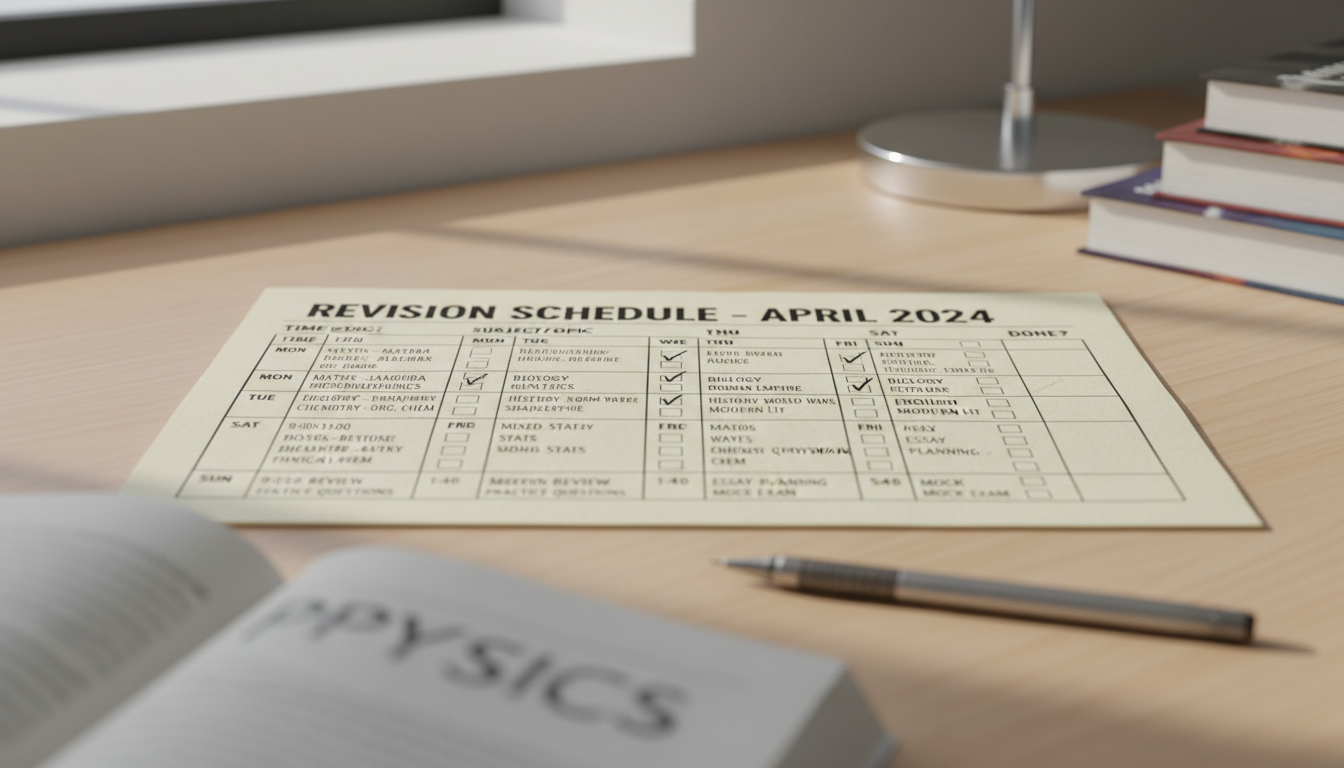
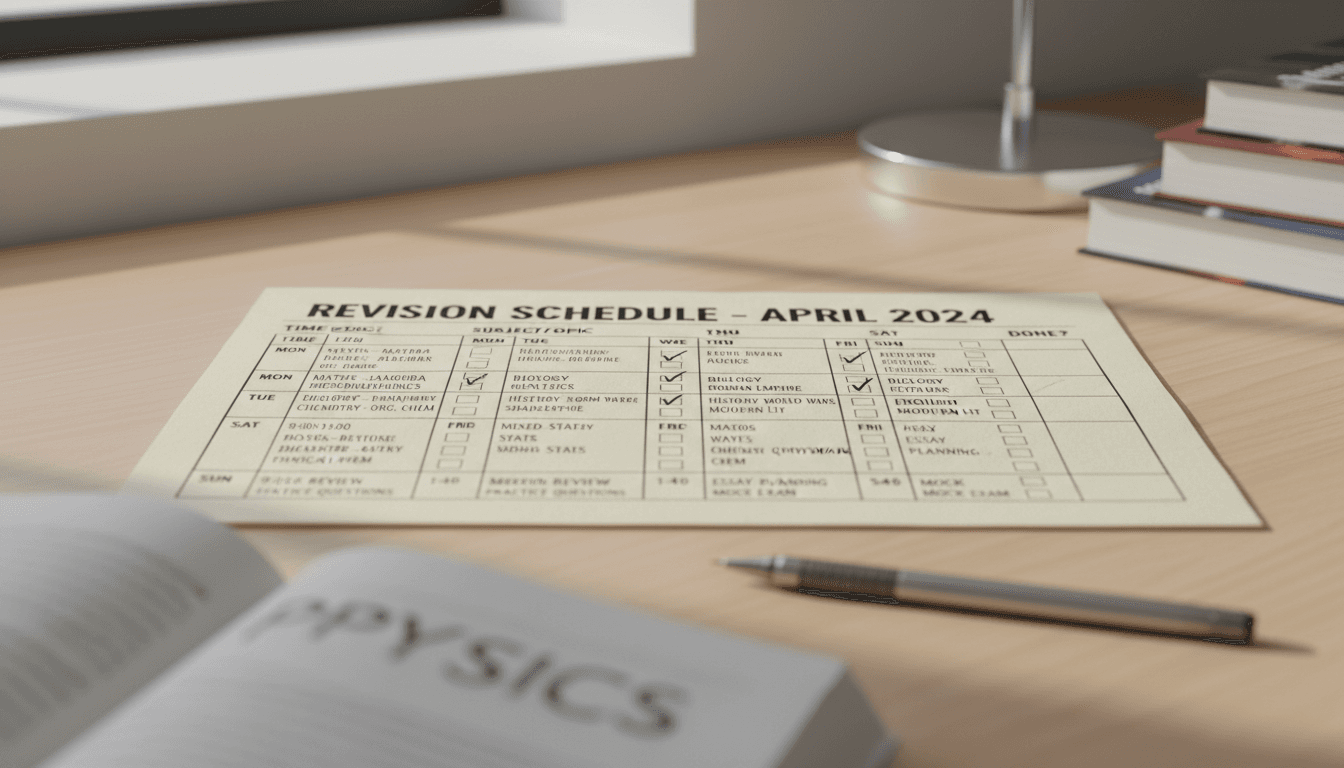
Moving from a strategic discussion with your teacher to a daily routine requires a structured, time-blocked schedule. For London students navigating long commutes and demanding extracurriculars, efficiency is the only way to avoid burnout. When your Year 12 A level maths mock results lower than expected, the temptation is to spend all your time looking backward. However, you must simultaneously master complex Year 13 content like parametric equations and advanced integration.
We recommend a '2:1' ratio. For every two hours spent on new classroom content, dedicate one hour to a specific error identified in your diagnostic first Year 12 mock revision. This prevents Year 13 from becoming overwhelming while systematically closing foundational gaps. Use your audit to pick one high-impact topic per week, such as log laws or circular measure, rather than trying to fix everything at once. This data driven recovery plan ensures that every minute spent at your desk translates into marks. If you need a schedule that fits your specific university goals, book a free consultation to receive a specialized revision timetable tailored to your current trajectory.
A disappointing mock result is not the end of the road; it is a clear indicator of where you need to focus your energy. By identifying weak spots and implementing a structured study plan, you can significantly improve your performance before the final exams. If you feel that personalized guidance would help you master these complex topics more effectively, our team at DataTutors is here to assist. Simply visit our Booking page to find a specialist tutor. Together, we can transform these challenges into a successful recovery.